Breaking the Left-Right Binary: How Multivariate Political Mapping Can Help Us Redesign Online Debate
14 Sep 2025
Reading time ~8 minutes
For the past few years, I’ve been spending more time trying to understand the paradox between free speech and regulating speech in safe spaces. I’m starting to conclude that the part of our struggle here lies in our language and that limits how we can think about the problem.
Inherently, these are political topics, so there’s inherent controversy that underlies the discussion, and that’s what I’ve been trying to resolve in my mind. However, because we refer to this with the term “political spectrum,” it often conjures up a one-dimensional line in my mind. I think it does in others as well, because we have the “left and the right.” In other words, it’s as if the “left” represents negative numbers and the “positive” represents positive numbers (or vice versa). That’s what creates this paradox: our current models don’t effectively address this problem, which keeps us perpetually stuck, leading us to think we can’t make progress. Before I dive into a mental model that works better for me, and then explore how I believe it helps us design better communities online, let’s break down what I mean by free speech and regulating speech in safe spaces.
When I say free speech, what I mean is that people should inherently be able and willing to say precisely what they mean. That doesn’t absolve them from the impact that their speech has on others. So, it’s necessary to cultivate environments where the interplay between a person speaking freely and the audience listening healthily is appropriately regulated. However, that regulation cannot come from a place of control; otherwise, it will inherently suppress most people’s willingness to speak freely, hence the paradox, because in any social setting, there’s an implicit social contract we agree to, which is to recognize and empathize with the impact we have on others. That is what makes us human, and to lose or break that social contract causes incivility. To resolve these conflicts, I believe the answer may lie in how we model and select individuals to put in a proverbial “room” or cyber-community to address a problem.
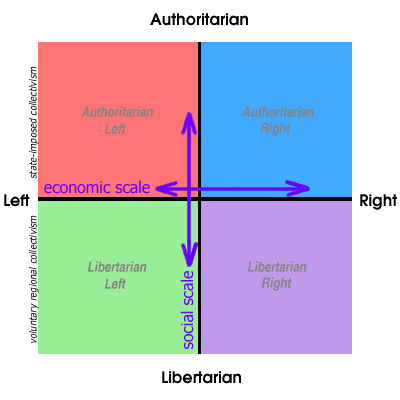
Let’s talk about a new (I didn’t invent it, I’m just re-applying it) model for mapping the political spectrum, then we’ll explore how to use this new model and what it might bring us. I believe the best model for mapping and visualizing the political spectrum is a multivariate spectrum using a radar chart, not a single-axis “spectrum” line or a two-axis “spectrum” (2x2 consultants square), and here’s why.
Single-axis political spectrum (number line)

source: https://politicalcompass.com
Two-axis political spectrum (quadrant graph)
Source: https://politicalcompass.com
Multivariate political spectrum (Radar Chart)
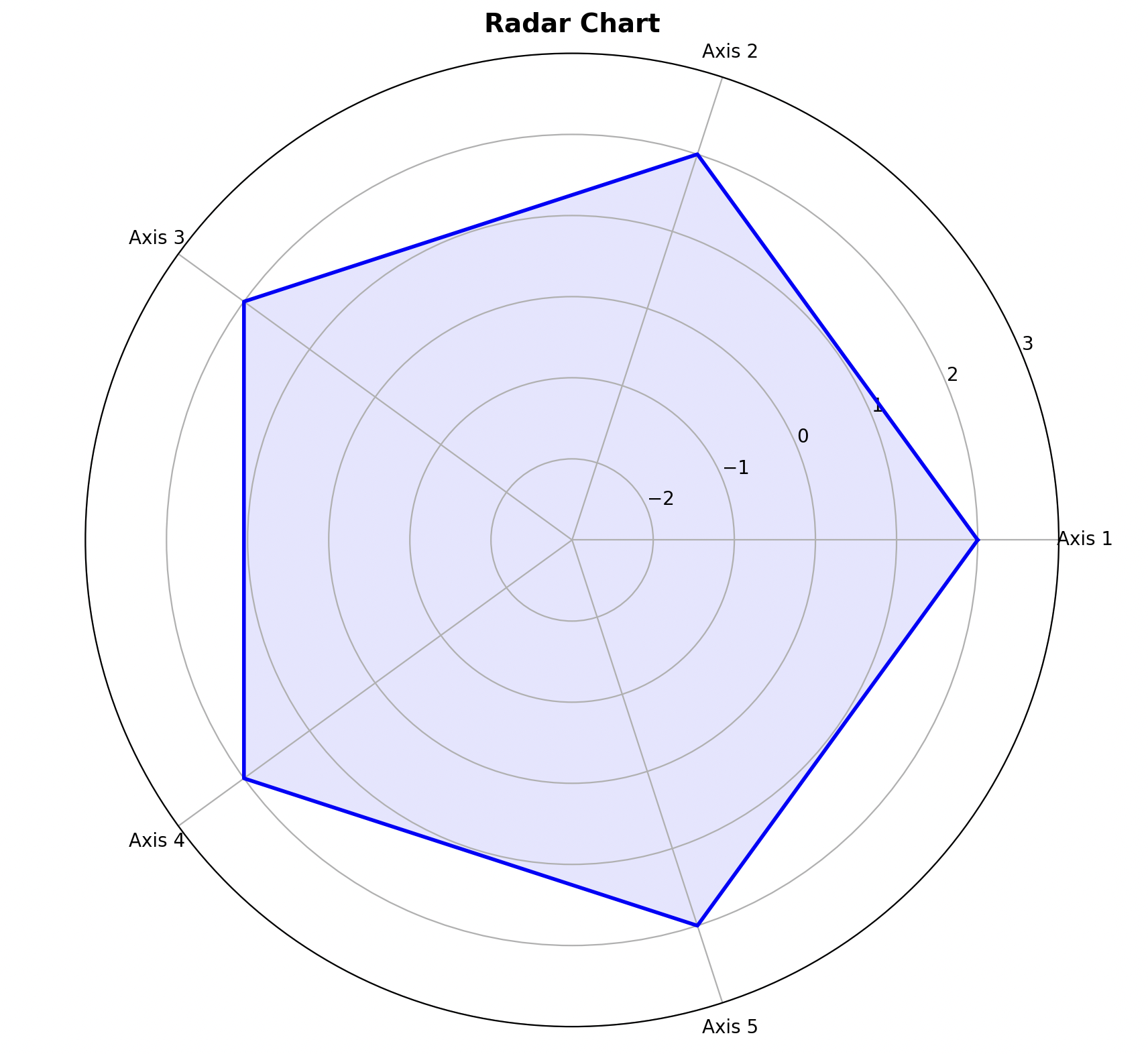
The problem with politics is that it is a multivariate by design. Put another way, the number of issues that any group of people can care about at one time is infinite and relative. As an example, today some of the challenging conflicts we’re working to resolve are political polarization (why I’m writing this in the first place), Immigration and national identities in a globally connected world, Poverty and economic disparity in a more interconnected world, and social identities that allow us to find our tribe. These are modern problems that don’t match the same difficulties they worked to resolve in 500BCE or 1250 (at least I wouldn’t think so, but I’m not well read on these eras). I’ve cherry-picked five broad categories, but there are many more! Think about what issue you care about most - does it fit within these 5? Probably not, and that’s the point.
So, if we recognize the problem is multivariate, how does modeling it differently help us? It helps us because it makes it easier to overlay one or more people’s individual radar charts on top of each other to identify where we have common ground, as well as where we’re probably too far apart to spend time focusing on a particular problem just yet. By doing this, we can carefully recognize which topics are best suited for any one community or set of people, like so.
Example Multivariate Political Spectrum - 2 People
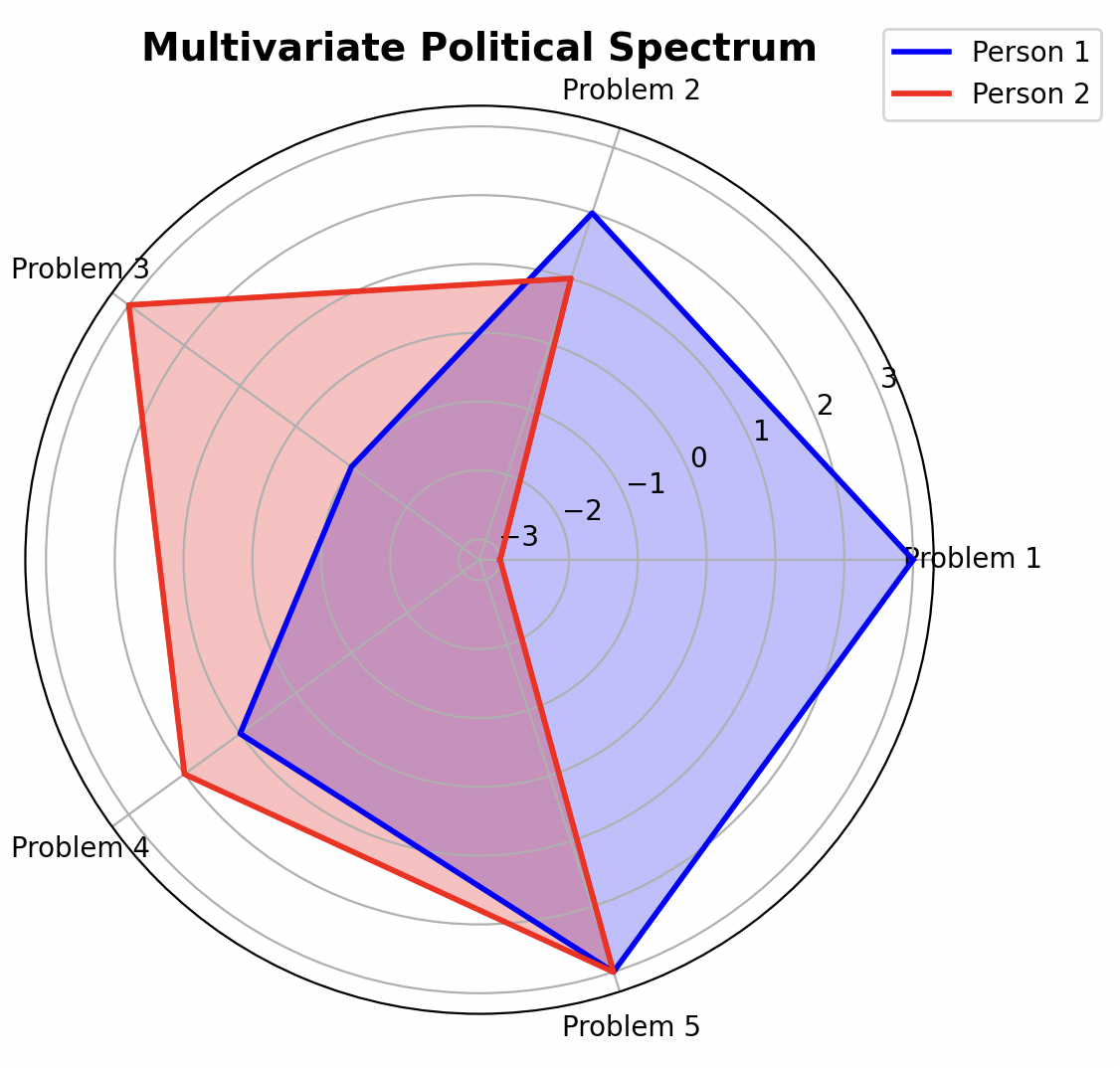
In this example, you’ll see that for problem one the people sit at the very opposite ends of the spectrum which suggests due to the polarization on the topic, it will be a touchy subject and might now be the best conversation for the two people unless there’s an established connection and high trust where they recognize that the difference of opinion will still be met with respect by the opposite party. The same thing is probably true for Problem 3, but Problems 2 and 4 are good points of discussion because there’s a gap, and the views are relatively similar, making it easier to have a discussion and shift views on these problems. Similarly, Problem 1 is a great starting point for establishing rapport and building trust between the two people.
Example Multivariate Political Spectrum - 10 People
Now, one can imagine the problem expanding to any number of people. To help visualize this, here’s one of 10 people with randomly generated values on where they fall within the spectrum for five different problems.
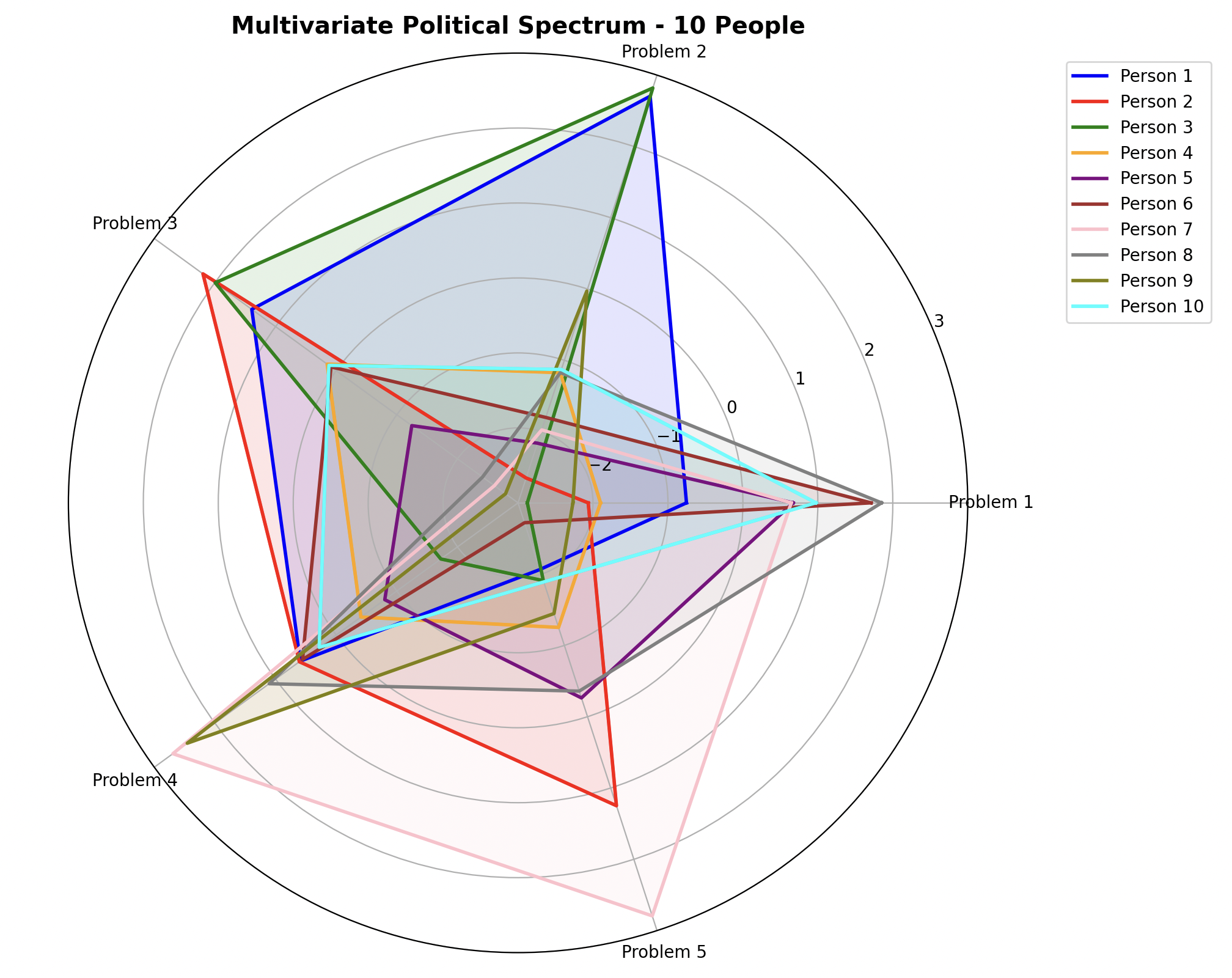
As you can see, it becomes increasingly complex to find common ground as more people are involved in establishing it. This complexity may contribute to why social media feels like a cesspool to debate political topics on, unless you find a sub-community that aligns with your views, or in other words, a “safe space”. With 10 people something like problem one would likely see battle lines drawn where Person 2, 3, 4, and 9 take one side and Person 5, 6, 7, 8 and 10 take the other side and depending on how the conversation goes Person 1 either goes silent and listens and gets pulled in one direction or another or acts as a moderator between the two sides.
Impact on Governance
It’s also indicative of the reason representative democracies appear to be struggling in the current era and new forms of governance like Algocracy and Futurarchy are being explored. Even with in a group of two, selecting a representative of that group is difficult because it’s unlikely to represent the views of both via a single person. When you add the complexity of a representing a populace of 10,000 the representation devolves to a tyranny of the majority. This complexity also means within a democracy we can’t focus on choosing the best candidate, but rather have to focus on removing those who no longer represent our views well enough. However, if there’s no trustworthy alternative replacement, we collectively accept what we’ve got over taking the risk of things getting worse due to the Doubling Back Aversion bias. It begs the question then of whether single-representation backed by party politics will be replaced with alternative forms of governance now that our methods of disseminating information have changed, but I digress.
Exploring the Solution Space
This new model evolves for me into how we can use the model to reimagine the tools we use to communicate online now. Now that we can model the behaviors of random participants, we can start to look at how we should shape technologies and tools like social media to regulate speech online without creating excessive control points.
For example, what if a social media platform recognized that Person 1 sits closest to the middle within the conversation and grants them moderation tools to moderate the thread? The idea of selecting a centrist to moderate on a topic I only came across as I was explaining the paragraph above, but it seems interesting. Maybe the tradeoff here is that the person with moderation powers isn’t interested in moderating or isn’t aware they are, so the conversation devolves too quickly?
Or what if we limited people’s access to specific communities based on your multivariate score? I’m less inclined to believe this is a good option because it seems like it would create Overton Silos when the goal of this is to bring people closer together and find common ground, rather than to bifurcate groups so that Person 2,3,4, and 9 only talk amongst themselves in one safe space, while 5,6,7, 8, and 10 talk amongst themselves in another.
Additionally, what happens if we made it easier for people to locally configure their own views into the platforms and technologies we use so that we can self-filter and self-select when we view the content versus when we don’t? For example, Brave Search has a feature called Goggles that does this sort of thing, where a person can configure their results to be returned based on boosting or discarding particular domains. This idea is fascinating to me, worth exploring because it operates under the foundation that “everyone is free to speak, but that doesn’t guarantee them an audience”. The difference between what we have today and how this would work is in who decides the audience. Today, the platforms decide for us algorithmically, but in the future, we could configure them ourselves and choose to self-regulate in a decentralized fashion.
These are some of the ideas I’ve been playing with, but the next steps are to explore how the tools and rules might work through using this new model. The nice thing is that within software engineering, machine learning is a scalable tool for addressing multivariate problems and building new platforms, too. Each profile on the platform is modeled as an array, and each index in the array represents a topic or category of discussion. You can then build optimized models to design different rules, such as the three mentioned. So the question I leave for my readers is, does this new visual model give you the exact “aha” moment that I had when I thought of it? Similarly, what ideas do you have for designing better tools for communicating on the Web?