I suspect you are unaware of the historical context behind the creation of copyright laws. So please grant me a week’s worth of your attention rations MiLord to read through this essay and understand my argument for why copyleft is incompatible with the milady worldview, in my opinion. I’ll do this by walking you through the history of censorship, drawing on my own learnings to illustrate why copyright laws exist and how they’ve been a means to reduce the agency of individuals. Then I’ll attempt to structurally disassemble your worldview to show why the very virtues you promote are useful, but only as a means to an end to move the collective Overton Window that emerges in society to promote further agency. Finally, I’ll attempt to nudge the narrative of cypherpunks towards a clearer set of goals that we can live up to and share with others. Now I don’t promise a clean utopian world view, as I’m a pragmatist, but I do promise a good faith attempt to offer a better alternative for the story of the cypherpunks. Which I hope is a bit closer towards a compromise we collectively land on in this era so the historical record marks us down as one step forward, not backwards, towards greater agency during our period in human history. So here goes.
Act 1: The History of Copyright Laws
In the 16th century, when the printing press was created as a technology, there didn’t exist copyright laws. The Inquisitions of the Catholic Church actually created the first copyright laws as a reward to printing press owners who maintained a monopoly on the distribution of printed information via their new technologies. By the 16th century, the Catholic Church had built up a stronghold on the distribution of information and morality through the lens of religion. At the time, the church operated as an institution with immense power that rivaled monarchies and allowed it to dictate the moral framework of society at the time. Not unlike the power that large technology platforms have today like social media platforms. And they utilized that power to maintain the status quo of the Overton Window but the change in technology meant the press owners could disrupt that status quo. So the creation of copyright laws was created to grant the press owners a seat at the table of elites, as long as they helped maintain the status quo by printing approved materials and censoring the rest of the marketplace of ideas.
The English company called The Stationers Company, which sat outside the jurisdiction of the church’s inquisition powers, saw these forms of laws as an opportunity to build a monopoly of their own. So they stirred a moral panic in England, claiming the Church was plotting to overthrow the government of the time. They manufactured this crisis as a means to an end, so that they could build a regulatory moat via censorial copyright laws for themselves in England. See, the business opportunity they created for themselves was that they would censor via inspecting any text they’d print for a fee. And it worked, not unlike what many of these age verification laws around the world are doing for tech firms today as a reply to the moral panic social media platforms created within modern society via ISIS and Cambridge Analytica’s actions on them. The big tech platforms just want a seat at the table of elites, and what they bring is a distribution of information and a willingness to censor for the elites to help autonomously scale the censorial power of the elite. Don’t believe me? Just look at the autonomous enforcement YouTube uses to create for the enforcement of copyright claims, such that creators today self-censor themselves in fear of automated de-platforming of their content, which strikes directly at their livelihoods within the attention economy of today. Therefore, it begs the question: Are you utilizing copyleft as a censorial power that you claim to despise or as a means to an end of a larger goal? Are those goals in pursuit of more agency for individuals or as a grift to acquire power through stroking the flames of the current moral crisis in hopes you too can get a seat at the table of elites via Remilia Corp, like The Stationer Company once did?
For a deeper insight into the historical contexts of censorship, I highly recommend Ada Palmer’s 2023 Nuveen Lecture, “Why we Censor: From the Inquisition to the Internet,” so we can collectively better understand the historical patterns and motivations of censorship. If it’s the thing we aim to critique, we must first understand the previous problems that our ancestors were attempting to solve through censorship and the control of information, and then utilize that information to understand how we want to respond.
Act 2: My Understanding of Milady World View and Its Impact On The EF
I’ll admit this is probably where I’m most uninformed, but from what I’ve gathered, the two core premises of Milady are to promote a world with free speech, free markets, free association, free information, and free thought as declared in the Cypherpunk Purity Spiral. While it makes noble claims, the methods by which it means to achieve them I call into question. Including the EF Mandate, which is akin to a top-down censorial mechanism. That’s because it relies upon actual censorship, which leads to coercive self-censorship in the same way the inquisitors found Galileo to be a heretic on June 22nd, 1633, for defending his heliocentric views, which violated the church’s doctrine of geocentrism. Now, might I remind you that the Earth rotates around the Sun, so why did the Church feel the need to prosecute Galileo as a heretic? Because it served as a means to an end to protect their power and created the actual self censorial power that led to Des Cartes modifying his publications on his Mind Body thesis. How might Des Cartes’ theories have instead impacted history had he not had to pander to the views of the church?
That is not unlike what EF employees are experiencing through the purity test of signing the mandate. Now I don’t subscribe to the idea that you had any direct impact on this decision, but the Milady world view advocated for by RemiliaCorp has inspired it by calling into question whether crypto is “cypherpunk” enough. So, Milady bears indirect responsibility through its use of soft power, and it begs the question is the actions of the EF mandate inspiring greater agency in the same way it begs the question: is your use of copyleft inspiring greater agency within society? Or are these actions attempts to capture power through censorship as an enforcement mechanism?
Side note, I am still a pragmatic capitalist, but only in so far as I recognize altruism doesn’t put food on my table. This is one example of the paradox I find myself in, and is why I don’t claim a position of utopian morality. Instead, I accept the messy tradeoffs as good enough, not perfect. See Loss Leader Software for more details on the economics we face here that lead to large tech firms becoming the powerful monopolies they are now. There are likely useful strategies for us to employ there.
So it may lead you to the question: Why do I see the actions of copyleft usage and the EF mandate as a misuse of censorial power that is un-noble? Simply put, because they’re precursors of enforcement that MAY be taken and set the grounds for establishing a coercive relationship, which reduces the agency of the counterparty.
See the statements of free speech, free markets, free association, free information, and free thought, as well as many of the statements made in the EF Mandate, are examples of moral subjectivism. What do I mean by moral subjectivism? It’s a moral claim that cannot be objectively ascertained, such that it can be collectively understood by all parties and universally accepted. I suppose that’s because collective morality rests on humans’ tool of language, which is a lossy encoding of information. Or in simpler terms, what “free speech” means to you is probably slightly different from what it means to me and from any person you ask about the topic while walking down the street. We as humans, because of language being our tool of communication, fundamentally make up our own interpretations of the morals we live by through our shared stories passed down with language (including copyrighting text being useful even when its historical context juxtaposes our worldview) and experiences, and then represent those values through our actions in our day-to-day lives. The question then becomes, how do we reach a shared understanding to establish an Overton Window for our shared governance systems if we’re faced with this problem?
The model of prediction markets is a good point of reference here. See, the concept of a prediction market is that we can ascertain information through the emergent properties of pricing. In the marketplace of ideas, we’re all putting in buy and sell orders of our ideas via negotiations in conversation. This establishes the collective Overton Window through the ideas that actually get accepted and passed around in the stories we tell ourselves and others. For example, I’m currently attempting to sell the idea that agency is the noble aim of the cypherpunk movement and hoping others will spend their time to read it, buy it, and resell it later. Only time can tell me if my idea is good enough through watching how the collective Overton Window shifts after I share it. That is why VPLv2 relies upon the consensual nature of the marketplace rather than censorial mechanisms like copyleft licenses of VPLv1. It is a better heuristic mechanism of agency because it relies upon mutual agreement rather than enforcement as a “just in case” measure, where an author can attempt to tip the marketplace in their favor through censorial measures. Just as the EF mandate creates a “just in case” feeling through self-censorship by requiring a signature or acceptance of severance.
Act 3: How shall we Cypherpunks pull the world instead?
Now, I’d like to address the reputation that I feel bothers some people, including Vitalik and many others with the Milady movement, and why I think it’s not something useful to our cause. The edgelord memes exported from the bowels of 4chan that are often used in an attention-seeking ritual but quipped as art in a menacing, yet playful disguise are counterproductive to our aims of growing the cypherpunk culture within wider society. That’s because within the broader society where we want to take back the digital landscapes we have to be strategic about how we play into the hands of the tech companies drawing the bridges up on us. We take back control of the digital landscapes not by convincing our counterparts in the debate of free speech that they’re wrong; instead, we’ve got to convince those who abstain that we’re the better option to support. This is not unlike a cypherpunk reflecting their values further by switching from Android to Graphene OS in search of agency. Or an abstainer who switches from Chrome to Brave out of the convenience of fewer ads when watching YouTube or browsing the Web. Or a citizen in the global south switching to a more stable dollar to protect their savings. Each one of these actions collectively represents further agency in different ways. This helps us push back where we need to in order to reclaim the digital landscapes. Furthermore, it provides us the representatives of these ideals to collectively assert our morals, such as free speech, free markets, free association, free information, and free thought better.
See, in technical governance bodies like IETF, the number of users you represent is your credentials for impacting society with your software, such that Cloudflare or Google has a lot more sway on the HTTP standard than the average cypherpunk maintaining their own server. So, how do we recruit more users to join our tribe and support our ideas to reclaim the digital landscapes from the managerial elite? We provide products the abstainers and the elites want and exploit the feedback loop of being able to shape our tools so we can shape ourselves. Then, when the managerial elite attempt to recapture control and nudge it closer towards authoritarianism to “maximize efficiency”, “enhance safety”, or whatever alternative reasons they offer, we push back as we did in the old days with SOPA and PIPA protests. But how we fight to achieve our goals matters more than just reaching them. That’s because it lays the foundations for us to build upon, while solving our next challenges we will inevitably face after this cycle of change.
In my opinion, we need to take this approach of utilzing the tyranny of majority heuristics that democratic institutions govern themselves by to our advantage. Since the biggest hurdle is convincing people to care more than it is convincing your counterpart to change their view, our ability to capture the abstainers is how we expand our values. Especially in the current attention economy meta, where there’s an infinite echo chamber of information, and we need to filter through it. In my view, though, we won’t achieve structurally sound foundations in a post-cypherpunk era through the use of edgelording behind pseudonymity via post-identity and post-authorship. In fact, you’re probably going to detract the abstainers from buying into our ideas and convince them towards the safety that big tech is promising in cahoots with the elite via age verification, social media bans, KYC laws, and the raft of other compliance mandates that emerge to protect the large private institutions we aim to disrupt.
I will say, though, I do agree that the utilization of pseudonyms via post-identity and post-authorship ideas can be an effective means to shaping the collective Overton Window. Just look at Silence Dogood as one example of how pseudonyms have been an effective tool to pull the Overton Window towards radical policies that created greater agency like the first amendment in the United States, which stuck around in the same way Galileo and Copernicus were right about heliocentrism and it’s now the dominant prevailing theory with a mountain of evidence. The Milady are the Silence Dogood to the Etherealize and Coin Center reps who have to put on a suit and go throw down in the halls of power on our behalf towards more digital agency. We just have to understand the landscape they play within better to help them with the soft power the Miladies have created to shift the actual laws that govern us.
For example, I often tweet about how I believe OFAC sanctions are structurally dangerous to our right to transact because they have fallen susceptible to the bad emperor problem. These days, OFAC sanctions are used as a means for the US to weaponize the hegemonic dollar and debank other nations through authoritarian pursuits. In my view, this is a dangerous policy that we need to reform through changing laws like the Bank Secrecy Act and MiCA.
In the same way we want them to change, we also have tools the US wants to export the US credit system to the global south and keep the petrodollar in tact for long enough to reduce the national debt and make it out of the economic war with China. Similarly, China is trying to out grow the US economy in an attempt to form a new economic order, and that creates an opportunity for us where they both utilize the digital asset rails we built to opt out of their system. Right now, stablecoins on Ethereum are the technological disruptor, and the financial system is offering the cypherpunks and crypto a chance to shift the conversation at the elite’s table. The pragmatist in me says take it because it’s an opportunity to form a triumvirate global economic order and shift the game theoretics as a whole from a 2 agent problem dominated by a Nash equilibrium to a multi-variate agent problem (China, US, EU, or DAOs) governed by an alternative means of equilibrium which compete to provide greater human agency to individuals who move around. This also seems less capable of falling into the bad emperor problem. That is, if we time it right and convince others it’s a better option. So please recognize there’s a potentially bigger strategy at play here and move beyond the edgelording and help write different rules, not recycle the old ones from the 16th century like copyright laws.
Now, if you want to edgelord in private as a means of releasing your anxiety and discomfort for the world you exist in, so be it. That’s the exact right I’m defending, so it would be hypocritical for me to try to stop you from doing so. Personally, I don’t plan to join in because I’d rather uplift others through a “rising tide floats all boats” strategy rather than a “misery loves company” approach. I also accept that if censorship emerges collectively through individual actions, that’s slightly better than the centralized censorship we escaped after the inquisitions and are attempting to recreate with bad laws. Hence why I made no attempt to modify the code, just the license, and also why I advocate for pragmatic views of user-controlled moderation instead of age verification. And in the attempt to express free association better, I’d expect our counterparts to try and pull things in their direction. But that at least creates an acceptable level of checks and balances, unlike what centralized censorial powers are doing, because some abstainers will take a bit longer to understand why a marketplace of ideas with user controlled moderation is better.
The reason I make this request in change of strategy and intentions is that you make it far harder for those of us who have to put on the damn suit and go negotiate with the elites who are looking for reasons to reject our ideals and say no. However, we can leverage what they want from us to Trojan Horse the infinite garden of CROPS tech we built into their systems via stablecoins, as a means to an end. From there, we can leverage that hard power we’ve created for ourselves from maintaining the network in a game of jurisdictional arbitrage via decentralization so that we can nudge the world closer to our morally subjective interpretations of our principles in the global marketplace of ideas and shift the Overton Window.
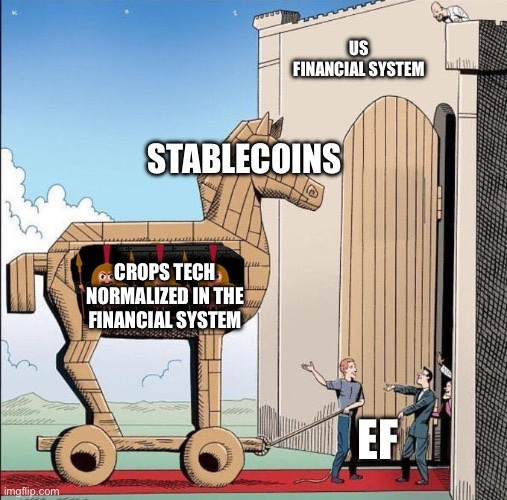
So the final rhetorical question I lay down is: Do we believe that we can leave the world in a better place than we found it, or are we just going to recycle the same centralized hierarchies that seem to be mathematically inevitable under current Nash equilibria, or do you want to pander to the nihilists for pennies on the dollar while feeding the attention economy? I at least know that LARPing as an nilihistic edgelord via pseudonymity while utilizing the same tools that have oppressed others before me isn’t my preferred way of nudging the Overton Window towards more agency. Nor do I think it comes from creating cults to sell more merchandise in the attention economy. Nor do I think it comes from enforcement measures like the EF mandate or copyleft enforcement mechanisms. Instead, I think it comes from producing things that help others exercise their agency just a bit more, so they achieve their own pursuit of subjective morals via that agency. And if the institutions that bring this about do it wrong than I expect ourselves to circumvent the accountability sinks like I toyishly did with TVL and be replaced just as we’re trying to replace those who came before us. The difference is I’m trying to play chess, not checkers here, and that’s why I don’t claim a utopian world view filled only by ideals and pseudobable and instead offer a specific goal for us. To deliver cypherpunk values to the world through things people want and need, but do so in a way that holds us accountable to the next set of cypherpunks if we screw it up. Only time and the collective Overton Window can tell me if this idea will be useful, though, and whether the idea I’m selling has any buyers.
Now it’s time for me to go touch grass.
